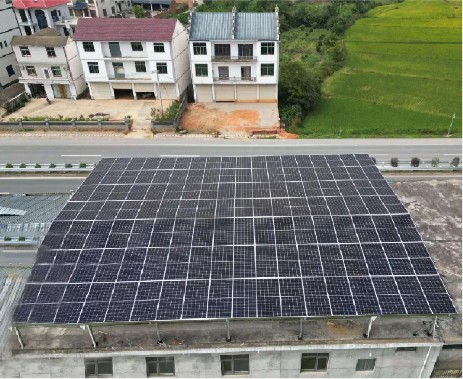
From January to September 2023, the national distributed photovoltaic capacity increased by 67.14GW, among which the household capacity grew by 32.98GW. Household photovoltaic power generation has risen comprehensively and is expected to become an important new growth point in the market under the joint impetus of rural revitalization and the dual carbon strategy. Xiao Yun has summarized the development trends of household photovoltaic systems and will share them one by one with everyone next.
01
Capacity alerts, market migration
—
The future development trend of the household market can be summarized in four words: the southward shift of the market.
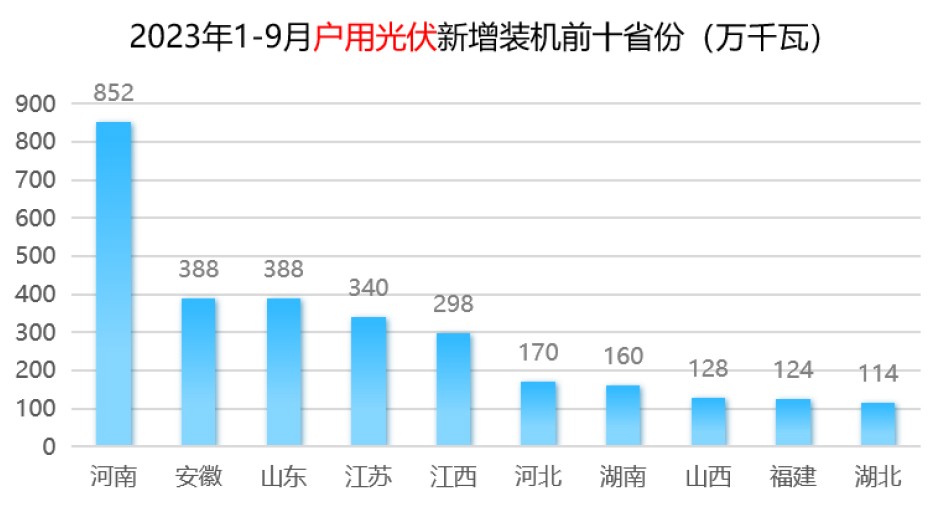

The above chart shows the top ten provinces in terms of new household installations from January to September 2023. Despite having no access space, traditional photovoltaic powerhouses like Shandong, Hebei and Henan still saw significant new installations.
Hubei, Hunan and Jiangxi, the three provinces in central China; East China, Jiangsu and Anhui Fujian in South China performed outstandingly.
With the continuous rush to install and the decline in costs, some areas with poor light resources or a demographic dividend will also form new growth points in the household market, such as Guangxi, Guizhou and Yunnan.
02
The single-household capacity has exceeded the 50kW limit
—
Another reason for the high growth of household photovoltaic installed capacity is that the installed capacity of individual households is getting larger and larger. In some provinces and cities, the installed capacity of individual households has already exceeded 50kW. In practical applications, there may be some differences in the filing process. In some areas, if the capacity of a single household exceeds 50kW, it is necessary to file as a non-natural person or project company.
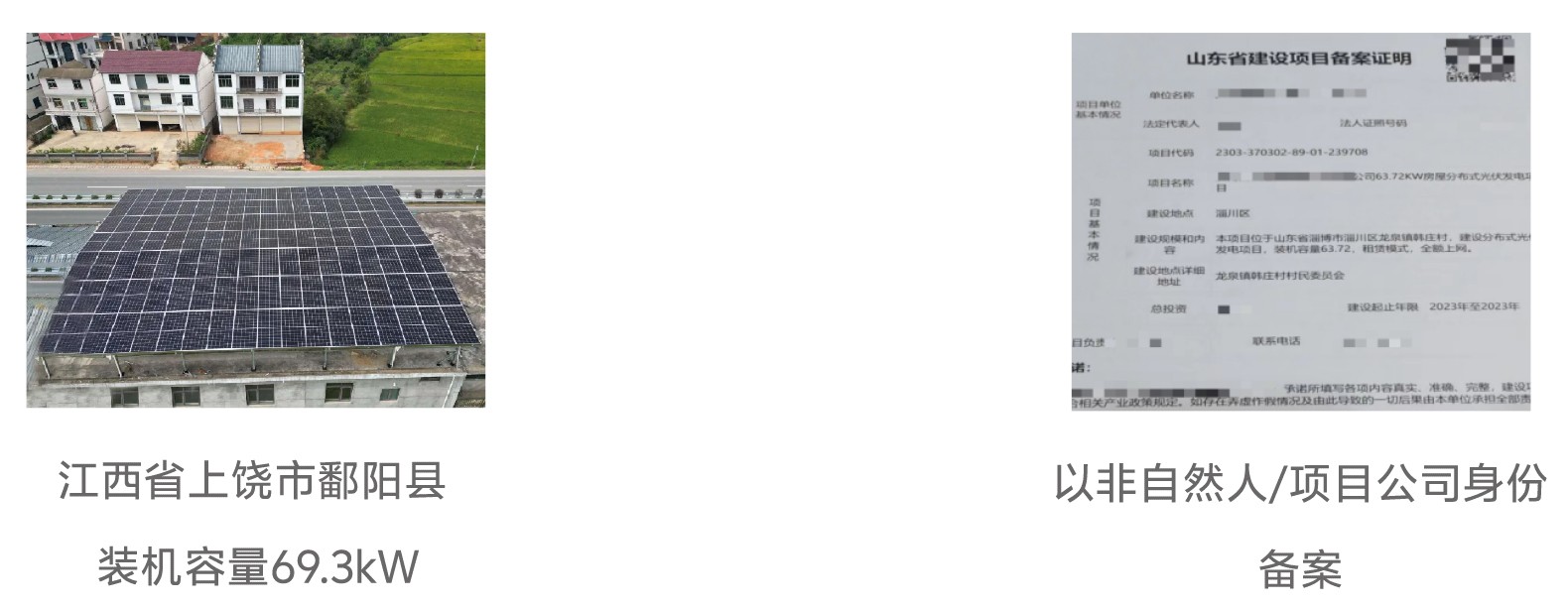
As the installed capacity increases, the power of inverters also rises, which leads to the application of commercial and industrial inverters in household scenarios. At this time, the installation location of the inverter should take into account the impact of noise and be as far away as possible from the residents' rest area. In addition, two low-power inverters can be used instead of a high-power inverter to reduce noise problems.
03
Diversification of rural rooftops
—
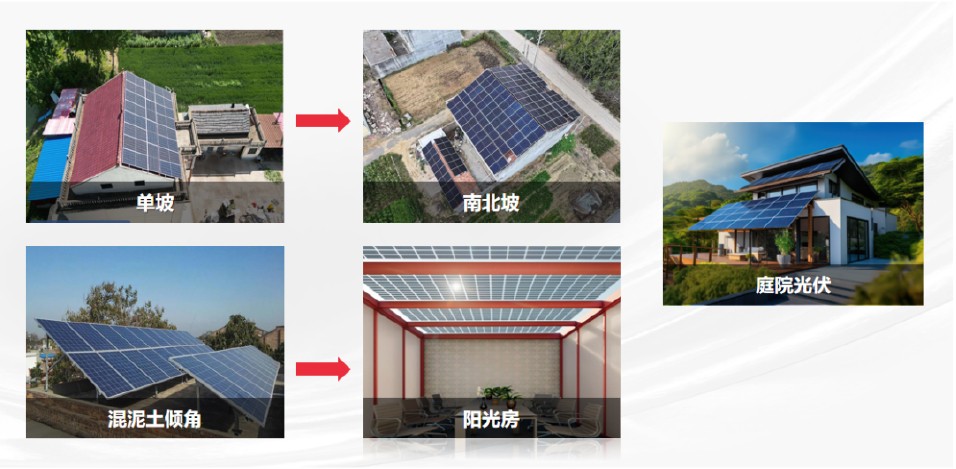
With the vigorous promotion of new energy by the state, the public's acceptance of photovoltaic power has increased, and their requirements for installation and aesthetics are also getting higher and higher. In addition, good rooftops are becoming increasingly rare, and rural photovoltaic rooftops are showing a trend of diversification: from single-slope to double-slope, from concrete inclinations to sunrooms and even courtyard photovoltaic systems. Both the north and south slopes are equipped, and the local people can also earn more rent.
04
Application of High-power components
—
Take the Huansheng 210 double-sided double-glass module as an example. The double-sided module has a backside gain, good anti-attenuation effect, and the double-glass is less likely to catch fire. When applied in scenarios like sunrooms, it brings more benefits to the property owners. On the other hand, under the same area, the number of its component blocks will be less, which can save some development costs and rent. Meanwhile, the reduction in the number of component blocks corresponds to a decrease in connection points, which can reduce the risk of generating direct current arcing.
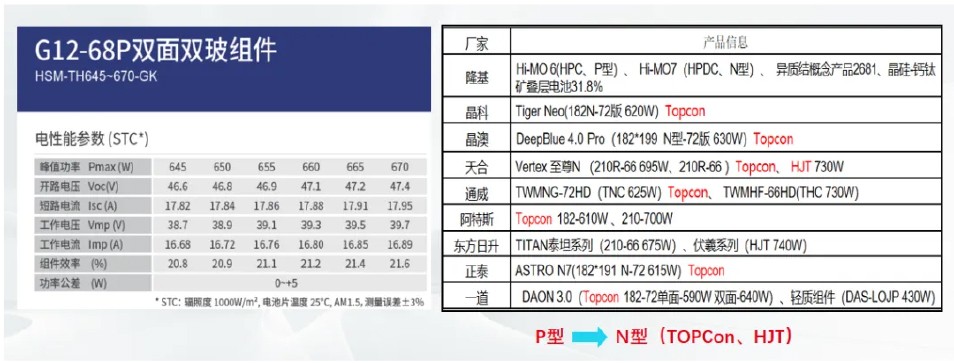
The right side of the above figure shows the technical routes of major component manufacturers. Considering the power generation efficiency and profit rate, high-efficiency battery processes such as TOPCon and HJT based on N-type silicon are increasingly favored by the market. In addition, in the centralized bidding and procurement of some central and state-owned enterprises, N-type batteries have occupied an absolute share of 70% to 80%. The trend of N-type batteries replacing P-type batteries is taking shape.
05
Inverters have higher requirements
—
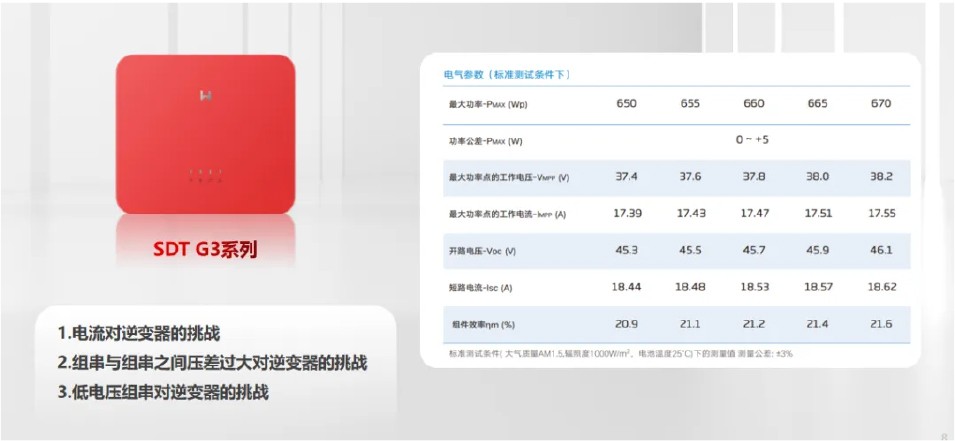
With the diversification of application scenarios and the continuous update and iteration of components, the market has put forward higher requirements for inverters. The current value of the high-power 210 module is as high as 18A, which puts forward higher requirements for the current value and adaptability of the inverter. When designing strings in the early stage, it is recommended that the number of components between strings be distributed as evenly as possible to avoid situations where the upper and lower limit components differ too much. If the pressure difference is too large, the low-voltage string needs to be boosted. Boosting the voltage will generate heat, limit the power output and reduce the power generation. In addition, it is necessary to ensure that the string voltage is within the full-load MPPT voltage range to guarantee that the machine can output at full power.
06
Rationalize the control of volumetric ratio
—
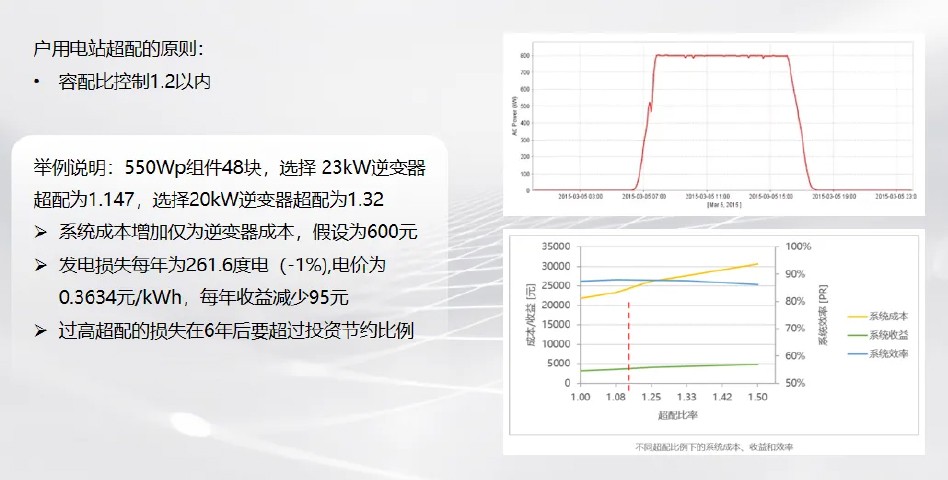
According to the project sites visited by Xiaoyun, the volumetric ratio is mostly controlled within 1.2. Xiaoyun gave an example to illustrate why it is operated in this way in actual projects: There are 48 550W components with a total installed capacity of 26.4kW. When choosing a 23kW inverter, the over-configuration is 1.147, and when choosing a 20kW inverter, it is 1.32. In the initial investment, the difference between the two inverters is 600 yuan. However, from the perspective of long-term power generation loss, The annual power generation loss of a 20kW inverter is 95 yuan, which has exceeded the investment cost in just six years. Therefore, in terms of long-term yield, Xiaoyun suggests that the capacity-to-yield ratio be controlled within 1.2.
07
Copper cables are mostly used on the AC side
—
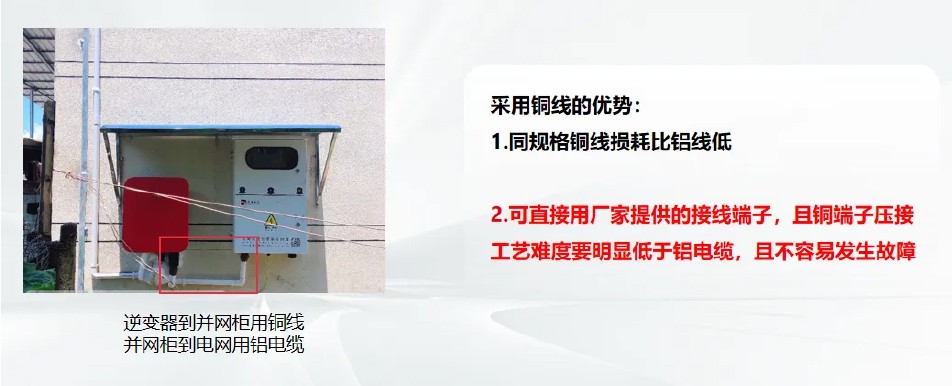
Nowadays, copper cables are more commonly used on the AC output side. There are several advantages to using copper cables: 1. Under the same specifications, the current-carrying capacity of copper cables is approximately 1.29 times that of aluminum cables, and the line loss is lower than that of aluminum cables. From the perspective of construction techniques, the inverter factory's trademark is equipped with copper terminals, and the crimping difficulty of copper terminals is simpler than that of aluminum cables. Many construction units directly connect aluminum cables to copper terminals during construction, resulting in the burning of AC terminals.
In household scenarios, the inverter is usually located near the grid-connected cabinet. Therefore, many platforms choose copper cables from the inverter to the grid-connected cabinet and aluminum cables from the grid-connected cabinet to the power grid.
08
The adjustable voltage on the AC side is required to be higher
—
Nowadays, there is a higher demand for adjustable voltage on the AC side. This is mainly because there are many power stations in the transformer area. When the output is good, reverse power transmission may occur, causing the voltage to rise. In addition, choosing smaller cables will also lead to a voltage increase. Therefore, some property owners have raised the reclosing switch specification from 275V to 290V, requiring synchronization on the inverter side to ensure the normal power generation of the machine.
09
Centralized convergence and voltage boosting for grid connection
—
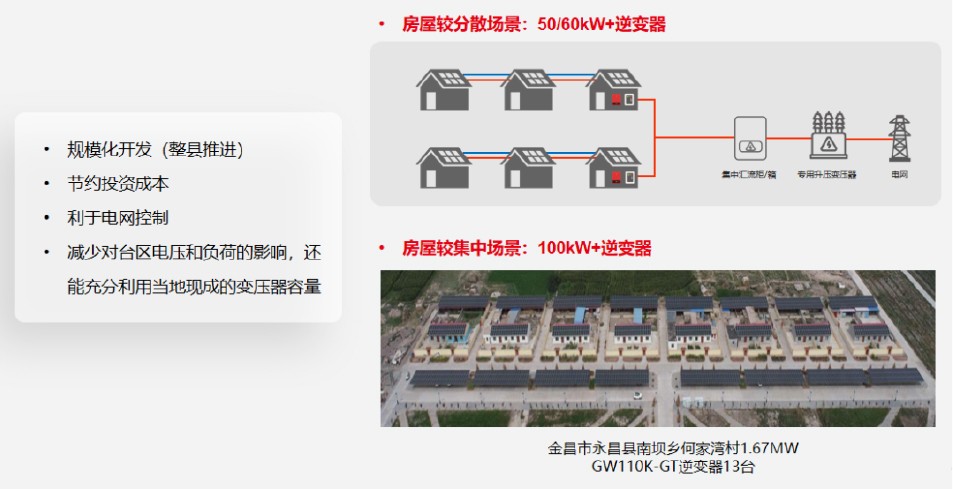
To address the issue of insufficient transformer capacity, at present, a centralized current convergence and step-up grid connection approach can be adopted. In areas where houses are relatively scattered, two or three households can share one small inverter. In areas with a relatively high concentration of houses, such as the project in Jinchang City shown in the following picture, commercial and industrial inverters can be used to facilitate unified control by the power grid and reduce the impact on the voltage and load of the transformer area. It should be noted that the installation location of the inverter should be as far away as possible from residential areas.
10
Pay more attention to the user experience in the later stage
—
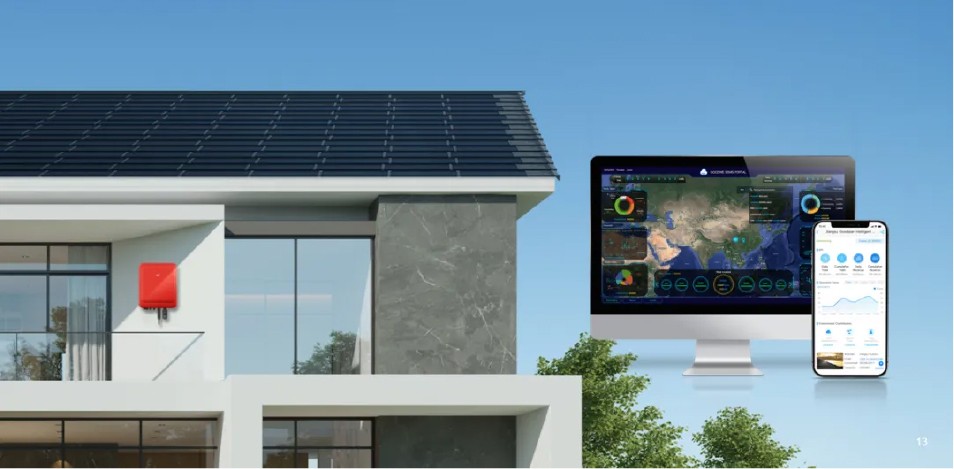
Power stations are getting larger and more numerous, and the subsequent operation and maintenance market is also very promising. User experience can be summarized into the following two points:
Comprehensive perception of the power station: You can check the parameters of the power station and the daily income at home.
2. Remote control of power stations: Timely push and record fault alarms. Handle power station issues at home. If the problem cannot be solved, go to the site.
The above are the top ten trends in household use summarized by Xiaoyun. Next, Xiaoyun will provide corresponding solutions for some scenarios.
Scene One
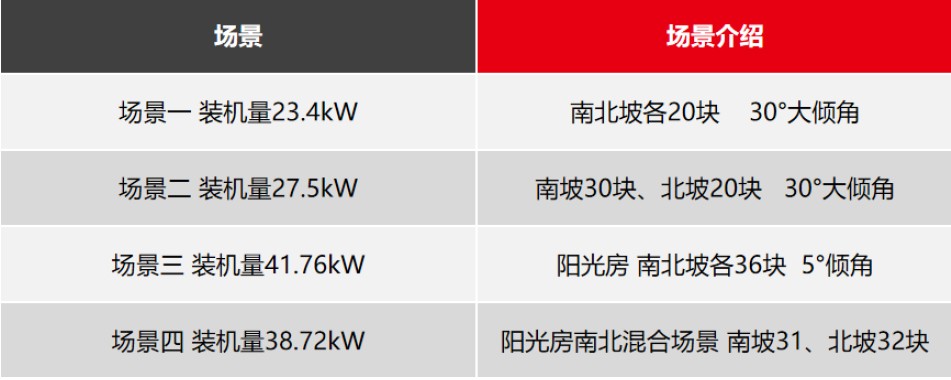
The north and south slopes each cost 20 yuan (30 yuan). Large inclination Angle
—
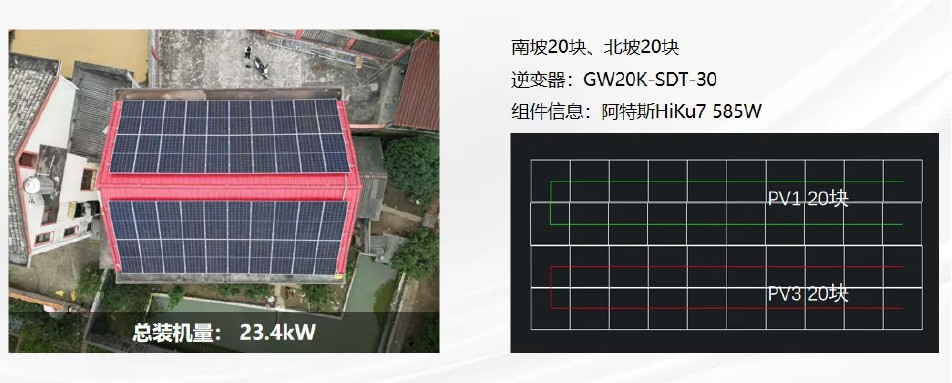
For scenarios where the number of components on the north and south slopes is the same, 40 210 components can be installed on the roof, with a total installed capacity of 23.4kW. Canadian Solar 585W components and Yunding 20kW inverters are selected. A 1100V open-voltage system is connected in a single string to 20 210 components, with one string on each side of the north and south slopes. When different MPPTS are connected separately, the utilization of the inverter is maximized.
Scene Two
30 yuan on the south slope and 20 yuan on the north slope. Large inclination Angle
—
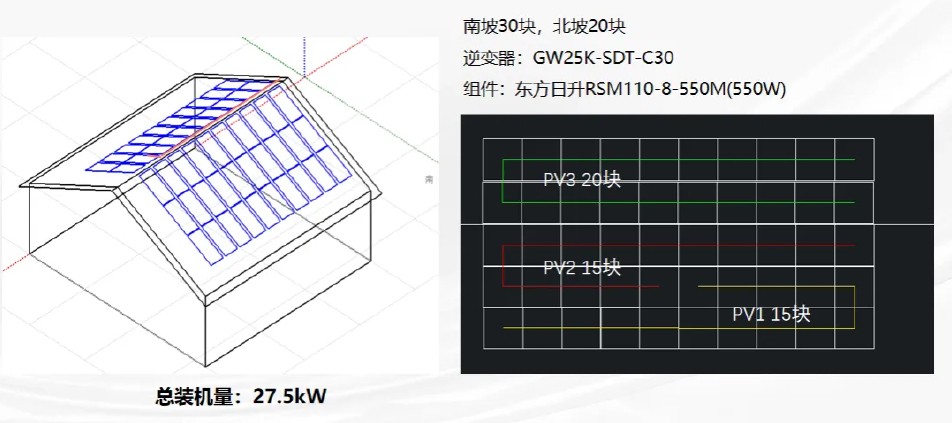
For the scenario where the number of components on the north and south slopes is different, the south slope has 10 more components than the north slope, making a total of 50 components on the north and south slopes, with a total installed capacity of 27.5kW. Sunrise 550W components and Yunding 25kW inverters are selected. The 30 components on the south slope are evenly divided into two strings, while the 20 components on the north slope are strung separately. The MPPT current of the 25kW inverter is 42¹22A, which can meet the connection requirements of three strings of 210 components. Two strings are connected to MPPT1 on the south slope, and two strings are connected to the north slope
Scene Three
Sunroom
There are 36 yuan for each of the north and south slopes (5). Inclination Angle
—
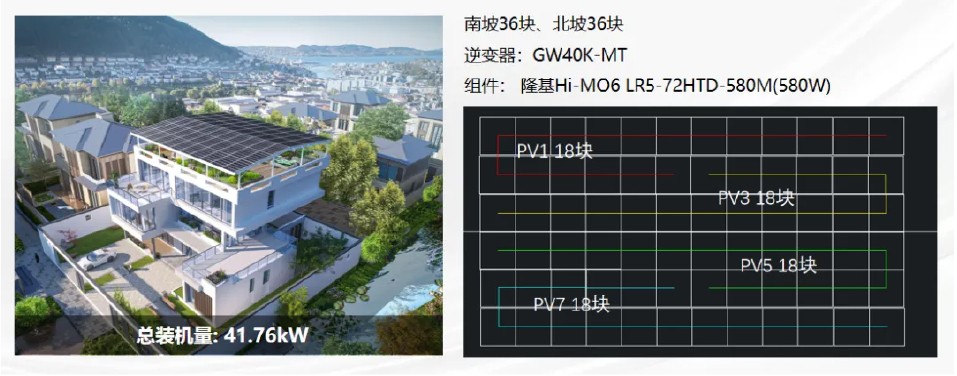
For the scenario where the sunroom is evenly divided between the north and the south, brackets are installed on the original flat ground to construct a 5° inclined north-south roof, which can serve to provide shade and rain protection. There are 36 components in each of the north and south, with a total installed capacity of 41.76kW. Longi 580W components and Yunding 40kW inverters are selected. The 40kW inverter has a total of 4 MPPTS, with an MPPT current of 30A. Two strings of 18 components in each of the north and south are respectively connected to different MPPTS.
Scene Four
A mixed scene of the sunroom in the north and south
31 on the south slope and 32 on the north slope (5). Inclination Angle
—
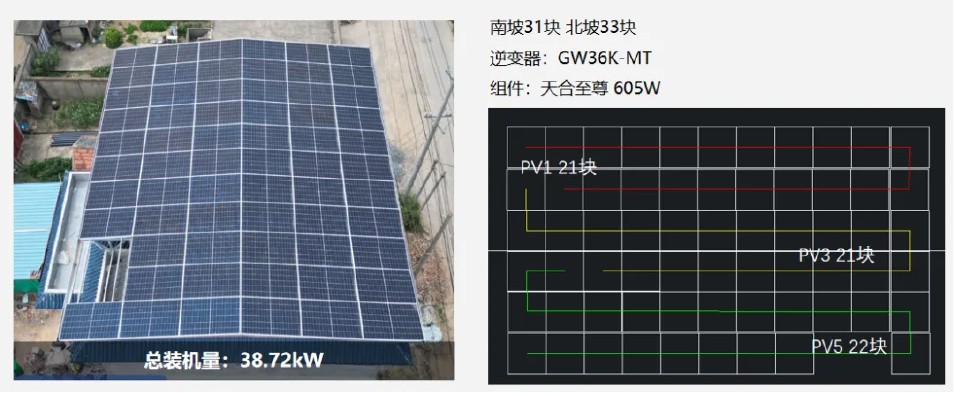
For the scenario where the number of units on the north and south slopes of the sunroom is unevenly distributed, there are 31 units on the south slope and 33 units on the north slope, with a total installed capacity of 38.72kW. Trina 605W modules and Yunding 36kW inverters are selected, along with three MPPTS, each with a current of 30A. Therefore, three strings of 210 modules can be connected. At a 5° inclination Angle, mixed connection can be selected. As shown in the above figure, 22 components on the south slope and 21 components on the north slope are respectively connected to MPPT1 and MPPT3 separately. The remaining components on the north slope and the remaining components on the south slope, totaling 21 components, are connected to MPPT2.
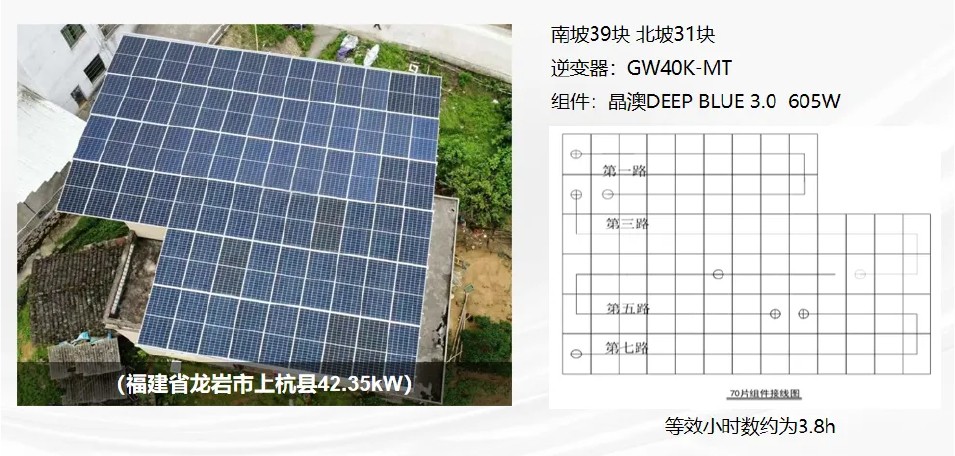
In the north-south mixed scene of the sunroom, there is also a horizontal inclination Angle of 5. The mixed connection cases within. There are a total of 70 JAMO 605W modules. The string design is shown in the above figure. Under the condition of ensuring the uniformity of the strings, it is necessary to ensure that the modules on the south slope (excluding those involving mixed connections) are connected as many as possible. According to statistics, the equivalent hours of this project are approximately 3.8 hours, which has a relatively small impact on power generation.
 Current position:Home Page >>Photovoltaic power generation >>Household photovoltaic power generation